








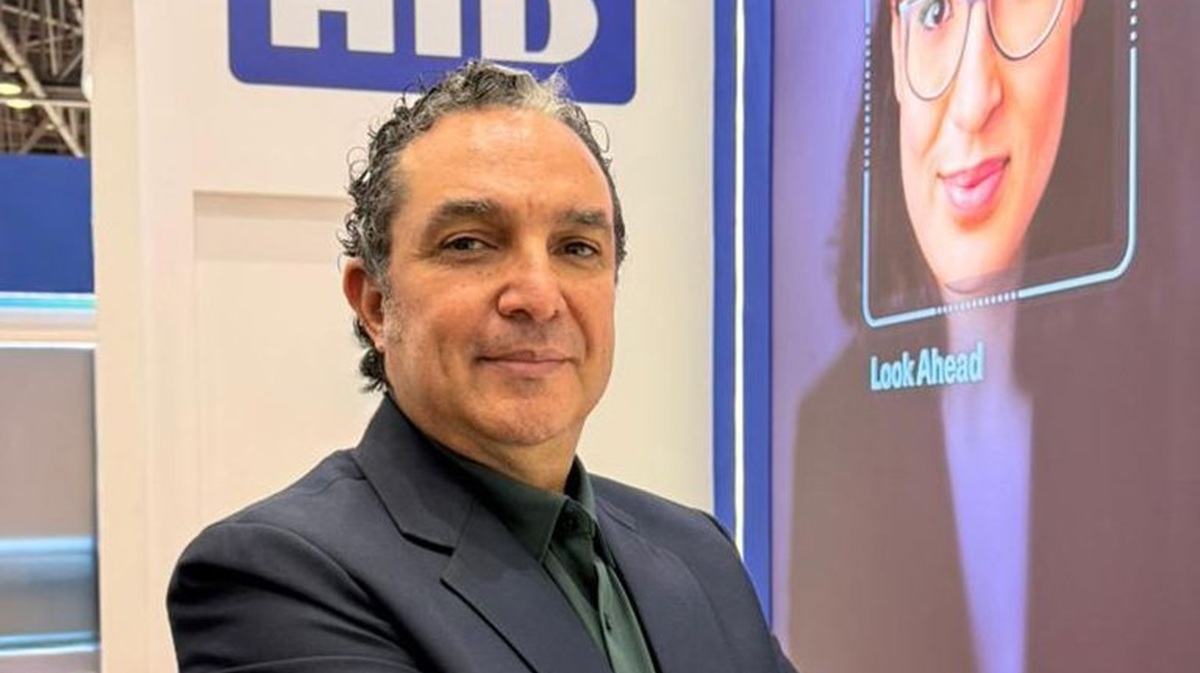
Sam Cherif, Senior Director and Head of the Middle East at HID, discusses market momentum, digital‑physical convergence, partner enablement, AI’s emerging role, and expansion across the Middle East and Africa as enterprise demand for secure, reliable access control rapidly increases.
You’ve been at Intersec for several years now. How has the show evolved in your view?
The show has grown tremendously. Attendance has increased significantly, and the number and diversity of vendors have expanded as well. This reflects the rising demand for security solutions across the region. The UAE’s reputation as a global business hub also plays a major role, attracting visitors from Latin America, the US, Europe, the Middle East, and Africa. For us, the foot traffic and engagement this year have been exceptional.
What new technologies are you showcasing at this year’s event?
As a leader in access control, we continue to present the latest generation of readers, physical cards, and controllers. But the portfolio has expanded in line with the region’s digital transformation. This year, we are showcasing biometric facial recognition devices, virtual badges, intelligent controllers, and cyber‑hardened physical security infrastructure, including mobile‑based solutions.
What sets HID apart from the competition?
We are the global leader in access control, and our focus is purely on enterprise‑grade solutions. Our differentiation lies in product reliability, brand equity, and decades of trust. HID is a US brand with more than 30 years of heritage, originating in the aerospace industry, where precision and quality are non‑negotiable. While competitors offer strong products, our brand recognition, lifetime‑grade reliability, and consistently top‑tier performance—validated by our customers—set us apart.
The Middle East is a mature market with many legacy systems. How do you approach upgrades and migration?
Legacy systems are not a challenge—they are an opportunity. A large installed base allows us to maintain strong relationships with critical end users while advising them on modern technologies. The market is shifting from purely physical systems to hybrid digital‑physical models, and we support customers through that transition. While some resistance exists due to cost considerations, especially in lower‑cost segments, enterprise customers are more open to innovation and understand the importance of upgrading. Concerns around cloud adoption—such as data privacy and residency—still exist, but we work closely with customers to provide the assurances and certifications they need.
Which sectors are most actively adopting your technologies?
We are a vertically focused enterprise, and our key sectors vary by market. In the UAE and Saudi Arabia, oil and gas, transportation, and critical infrastructure remain essential. Hospitality is growing rapidly, higher education remains strong, and healthcare is emerging as a major vertical. Commercial real estate is also gaining momentum, especially with the adoption of virtual IDs through Apple and Google Wallet.
How do you ensure your partners stay aligned with evolving technologies?
Partner enablement is a major priority. We invest heavily in training and maintain a stable, long‑standing partner network across the region. We bring partners together for HID‑focused events, provide continuous face‑to‑face and online training, and involve them in consultant forums. We also train our partners’ customers to ensure the entire ecosystem stays informed and capable.
AI is now part of every conversation. How is HID approaching AI within physical security?
It is still early days for AI in physical security infrastructure. We know AI will play a role in automating tasks, analyzing data, and presenting insights that help decision makers act faster. However, for vital systems, the extent of AI’s role is still evolving. Today, AI helps with data pooling, trend identification, and analysis, but critical decisions remain in human hands. Internally, we have begun using AI tools, including Microsoft 365 capabilities, across product, financial, and engineering analysis.
Your region is vast. Which markets are your current priorities for expansion?
The UAE and Saudi Arabia remain our strongest growth markets. Beyond the Gulf, we are reinforcing our presence in sub‑Saharan Africa, where several West and East African countries show strong potential. In North Africa, Morocco and Egypt are emerging as key markets, and we continue to invest in both.
What kind of investments are you making in these markets?
Our primary investment is in people. We are placing more channel sales managers and end‑user business managers in key countries. We are also expanding our distribution networks and, in some markets, establishing our own legal entities to strengthen our presence and support.
What do you look for in a distribution partner?
The first requirement is a strong enterprise orientation. We focus on enterprise‑grade distribution rather than lower‑cost segments. We also evaluate financial strength, market coverage, distributor pedigree, value‑added capabilities, and regional potential. These factors ensure that our partners can support the scale and quality our customers expect.
And what about system integrators?
We interact with all parts of the ecosystem, but we prefer not to work directly with smaller local integrators. Instead, we rely on global system integration houses—such as Honeywell, Genetec, Bosch, and others—to fulfil that role. Our distribution partners then engage with the broader SI community. We remain available to train system integrators across all markets, ensuring they are equipped to deploy our solutions effectively.
What growth are you targeting over the next 12 months?
We expect double‑digit growth, and not just marginal double digits. Given that the industry itself is growing at a double‑digit pace, we aim to capture additional market share. For a company of our size, mid‑20% growth is a realistic and healthy expectation.