










SAS continues to expand its portfolio of industry‑ready AI agents, models and accelerators as organizations struggle with the realities of deploying AI at scale. Many enterprises face a widening talent gap, limited sector‑specific AI expertise, budget constraints and governance challenges that slow adoption. As pressure mounts to innovate responsibly, buyers are seeking practical, safe and production‑ready AI solutions. SAS’ ongoing $1 billion investment in industry solutions reflects this need, with new offerings arriving in 2026, including SAS Supply Chain Agent, now in private preview.
SAS Supply Chain Agent is designed to streamline sales and operations planning (S&OP), a traditionally complex, multi‑day process that requires teams across retail and manufacturing to manually forecast and allocate inventory months in advance. Historically, most organizations could only run S&OP monthly due to the time and resources required. SAS Supply Chain Agent changes this dynamic by running continuously, balancing demand, supply and operations in near real time. Users can forecast needs based on usage patterns, reduce waste, optimize inventory and maintain ongoing visibility into supply chain performance. Through an intuitive chat interface, business users can explore scenarios, test assumptions and receive transparent explanations of how decisions are generated.
Industry analysts see significant potential. “Current pre-packaged agents tend to tackle basic processes; with Supply Chain Agent, SAS is compressing a very complex process, which could deliver significant value,” said Kathy Lange, Research Director at IDC’s AI, Data, and Automation Software practice. “This offering positions SAS to bring its longstanding supply chain knowledge to a new generation of agentic AI solutions.”
SAS is also advancing digital twin innovation. Using Unreal Engine, SAS creates virtual replicas of industrial environments, enabling customers to simulate scenarios and diagnose operational bottlenecks. One medical device sterilization provider used a digital twin to uncover the true source of a production delay, allowing them to optimize throughput and improve service reliability.
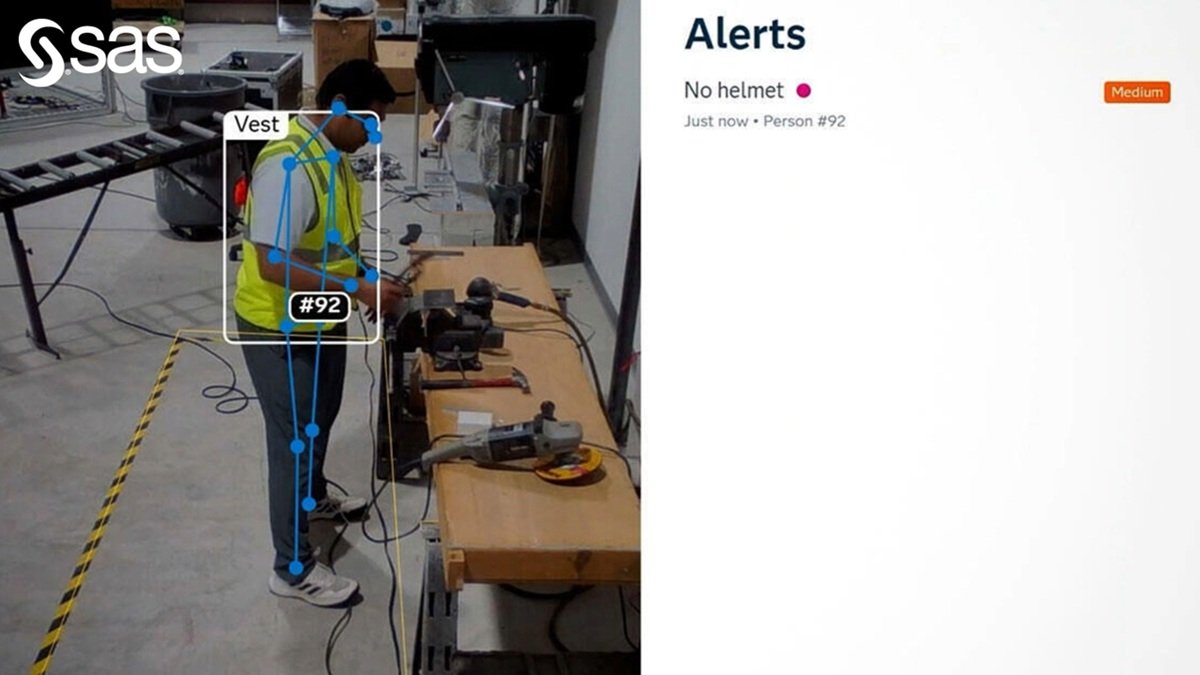
Worker safety is another area transformed by SAS. Through synthetic data, digital twins and computer vision, SAS Worker Safety helps organizations model rare but high‑risk events and train AI systems without exposing real employees to danger. These models can then be deployed across facilities to detect unsafe conditions in real time.
Across financial services, SAS Fraud Decisioning for Payments equips institutions with models trained on millions of fraud events contributed by global banks. These models help organizations detect emerging fraud vectors, including deepfake‑enabled scams and GenAI‑driven document forgery.
SAS’ industry accelerators are built on five decades of domain expertise and integrate seamlessly with existing workflows. “We’re engineering industry accelerators with purpose: to solve defined, real industry problems in highly regulated environments,” said Manisha Khanna, Global Market Strategy Lead, Applied AI at SAS. “With production‑ready agents and models that work on data they already have, our customers across industries can and are achieving extraordinary outcomes.”