










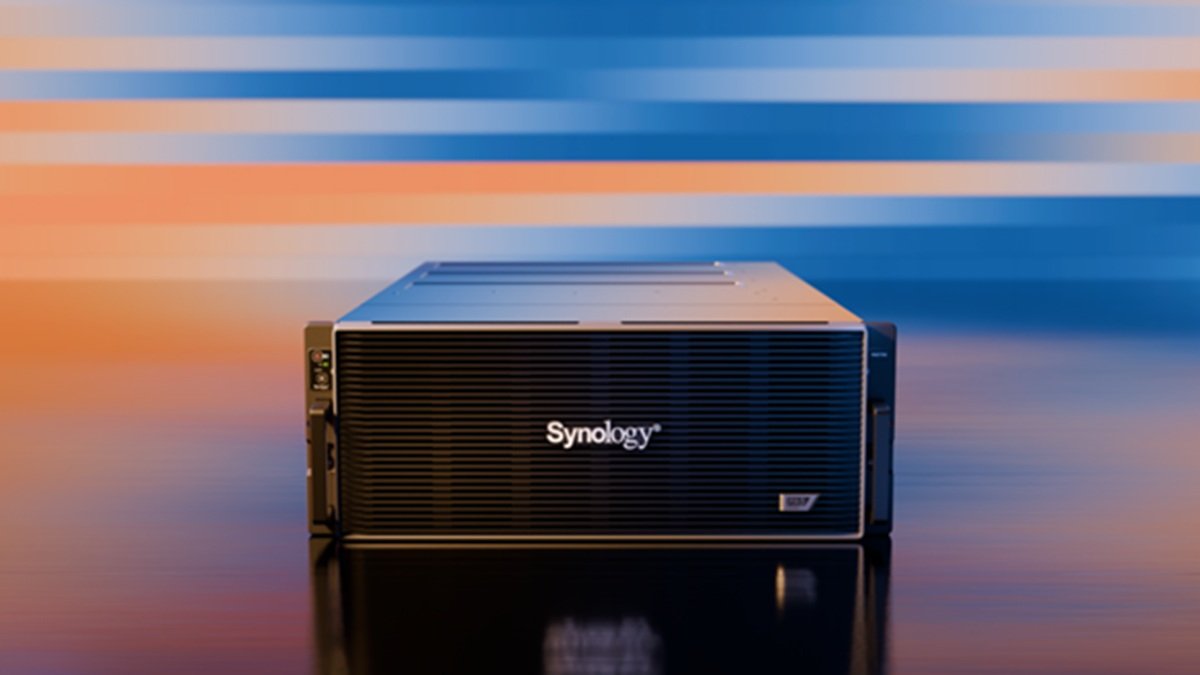
Synology has announced the availability of PAS7700, the company’s first active-active, all flash NVMe storage system. Built for mission-critical workloads, PAS7700 delivers enterprise-grade performance, uninterrupted resilience, and optimized operational efficiency.
“PAS7700 reflects Synology’s 25+ years of experience in storage and our close collaboration with enterprise customers to address evolving requirements for high availability, performance, and scalability,” said Bie-i Chu, Executive Vice President of the Synology NAS Group. “After a year of extensive real-world validation through our enterprise proof-of-concept program, PAS7700 is field-proven to deliver high reliability and performance, while helping customers lower total cost of ownership (TCO).”
High-performance storage for demanding workloads
PAS7700 features a dual-controller architecture and 48 NVMe SSD bays in a 4U chassis, scaling up to 1.65 PB of raw capacity with support for up to seven expansion units. It offers broad compatibility across both file and block protocols, including NVMe-oF, iSCSI, Fibre Channel, SMB, and NFS.
Equipped with up to 2,048 GB of memory and 100GbE networking, PAS7700 delivers up to 2 million IOPS at sub-millisecond latency and throughput up to 30 GB/s.
Built for continuous uptime and data resiliency
PAS7700 is engineered for environments where downtime and data loss cannot be tolerated. Its active-active architecture delivers multi-layer redundancy through RAID triple-parity, synchronized in-memory write protection, IP failover, and protocol-level failover, ensuring continuous operations even during unexpected incidents.
Built-in features including Self-Encrypting Drives (SEDs), Write-Once Read-Many (WORM), shared folders, immutable snapshots, Snapshot Replication, and Hyper Backup give organizations access to Synology’s proven suite of data protection tools out of the box.
Optimize cost and storage efficiency
PAS7700 enables organizations to optimize storage efficiency and reduce costs. Advanced deduplication minimizes storage consumption across large-scale enterprise workloads. Additionally, upcoming support for Synology Tiering will automatically allocate cold data to lower-cost storage based on customizable policies, reserving high-performance storage for active workloads.