










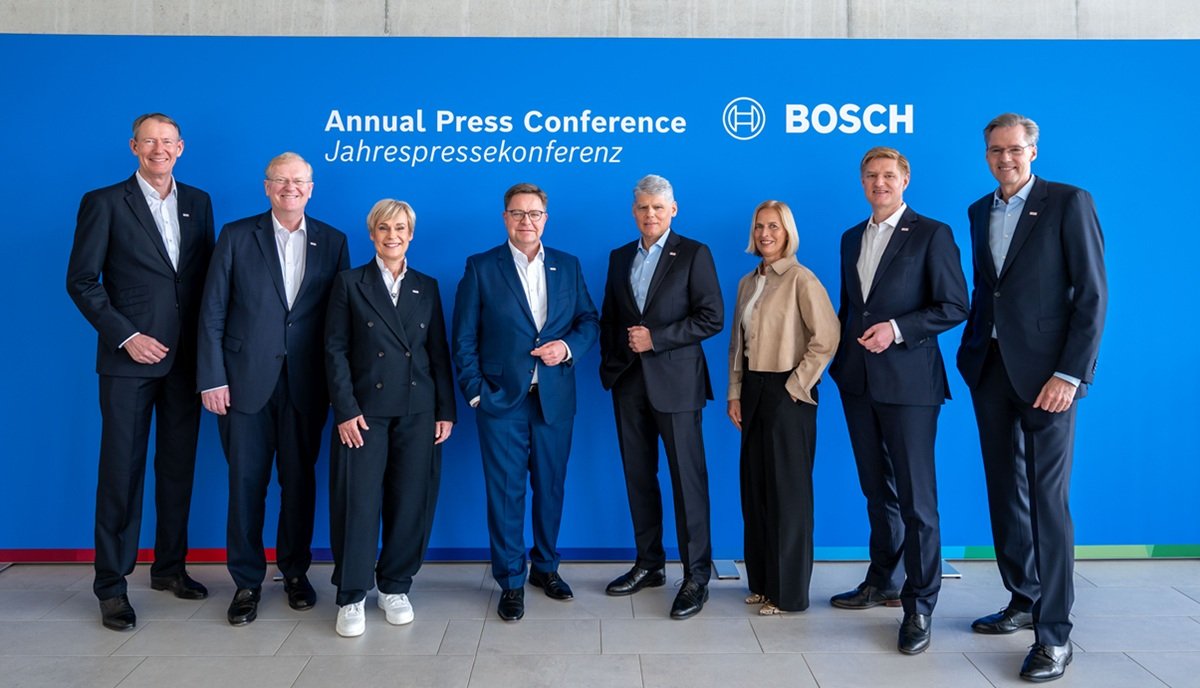
The Bosch Group is entering the 2026 business year with a strategy centered on innovation, cost competitiveness, and targeted investment, despite geopolitical tensions and persistent global trade barriers. According to the company, Bosch plans to leverage growth opportunities across its international markets while maintaining upfront investments at the high levels of previous years, including 12 billion euros in R&D and capital expenditure in 2025.
Bosch is forecasting 2–5 percent sales growth and an EBIT margin of 4–6 percent for 2026. Chairman Stefan Hartung emphasized the company’s commitment to shaping major technological trends, stating that Bosch is focused on “automation, digitalization, electrification, and artificial intelligence” as the foundation for profitable expansion. Bosch’s innovative strength remains a competitive advantage, with 6,300 patents registered in 2025, making it one of Europe’s most prolific industrial patent applicants.
In 2025, Bosch generated 91.0 billion euros in sales, a slight increase from the previous year, with 4.1 percent growth after adjusting for exchange‑rate effects. However, the EBIT margin fell to 2 percent, impacted by 2.7 billion euros in structural and personnel provisions aimed at strengthening long‑term viability.
Looking ahead, Bosch expects global economic conditions to remain weak in 2026, influenced by geopolitical uncertainty and inflationary pressures. CFO Markus Forschner noted that enhancing competitiveness is essential to maintaining resilience and investment capacity. To improve financial flexibility, Bosch will publish interim consolidated financial statements for the first time, enabling more agile access to capital markets.
Innovation remains central to Bosch’s growth strategy. The company is advancing sensor technology, robotics, and automated driving, supported by platforms such as the BMI5 sensor and next‑generation inertial sensors. Bosch also sees strong potential in software‑defined mobility, highlighted by its new AI Extension Platform, which personalizes vehicle experiences through interior sensing and AI‑driven adjustments.
AI is also accelerating growth in consumer goods and services, from AI‑enabled ovens to advanced power tools and digital mobility services. Bosch Global Service Solutions expects double‑digit sales growth by 2030 driven by AI‑based applications.
Despite economic headwinds, Bosch closed 2025 with 300 million euros in free cash flow, an 8.7 percent R&D ratio, and a 41.6 percent equity ratio, underscoring its financial stability as it enters a pivotal year of innovation‑driven expansion.